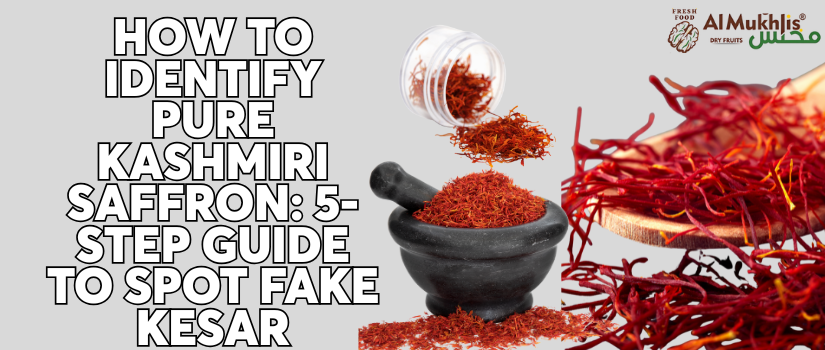
The most expensive spice in the world is Kashmiri saffron, also known as red gold, which can sell for as much as Rs. 3 lakh (INR) per kilogram due to its high production costs and health benefits. Due to its high price, Kashmiri saffron has become one of the most popular kinds of saffron on the market and is an attractive target for counterfeiting. It is estimated that 90% of all saffron sold globally is either fake or adulterated.
If you purchase counterfeit kesar, whether for health reasons, cooking, or using it in your beauty routine, you are losing your money and missing out on the true therapeutic qualities of saffron. Unfortunately, many people who want to buy authentic Kashmiri saffron unknowingly purchase it from unverified sources.
Instead of real Kashmiri threads, they receive dyed corn silk, safflower, or treated horse hair that looks like Kashmiri saffron but is fake. This guide will give you the knowledge and tools needed to easily identify pure Kashmiri saffron, allowing you to purchase high-quality kesar with complete confidence and experience its maximum benefits.
The reason that Kashmiri Saffron is counterfeited at such rates is simple: knowing the reasons behind saffron fraud will shed light on how saffron fraud occurs. Saffron is obtained from the stigma threads of the Saffron flower (Crocus sativus L.), and each flower produces only three stigma threads, making the cultivation process very labour-intensive. For every kilogram of saffron produced, approximately 150,000 flowers must be grown. A lot of saffron for a very high price is based on the fact that it takes a lot of flowers to produce a very small amount of saffron.
Saffron's limited supply has created significant profit opportunities for those who wish to commit fraud. The following are examples of the main methods used to counterfeit saffron:
The Colour Test: Authentic saffron threads are a dark red colour with an orange tint. Since it is unique to nature, the authentic two-tone colouration cannot be mistaken for a fake product. A fake product will have one of three characteristics: uniform bright red in colour (the result of artificial dye), dull or pale in colour, or excessively orange in colour.
The Trumpet Shape Test: Saffron threads have a characteristic trumpet shape with a bulge on one end (the stigma). The bulge is an important part of determining authenticity; counterfeiters find it difficult to accurately create the unique three-dimensional feature of saffron threads. You can determine if your saffron is authentic Kashmiri saffron by holding the threads up to the light. You will see the trumpet shape or trumpet-like bulge on the base of the string.
What to Look For:
Red Flags:
This is the best way to test if saffron is real or not: To test, put saffron in room temperature water (about 60°F) and leave it sit for 15-20 minutes. Real saffron gives a very bright gold colouring after being soaked for a period of time, while fake saffron gives a red colouring immediately or no colouring at all.
How to Perform the Test:
Expected Results for Pure Kashmiri Saffron:
Fake Saffron Warning Signs:
The baking soda test is a reliable method for determining whether or not saffron is authentic because authentic saffron will turn the baking soda solution a yellowish colour, while fake saffron will turn the baking soda solution red/orange. The chemical reaction between baking soda and crocin (the active compound in saffron) confirms the presence of genuine saffron.
How to Perform the Test:
Results Interpretation:
The test is based on the fact that crocin and picrocrocin are two of the compounds in saffron that produce a chemical reaction with baking soda, which results in a yellow colour. Artificial red food colouring added to saffron does not produce this reaction; therefore, if any false colouring was added to saffron when it was sold, it will not show this test, as it will not be reactive with the baking soda.
Genuine Saffron Displays unique sensory characteristics that can be difficult for imitation to imitate convincingly in either aroma or taste in its natural state. The Saffron will provide an Aroma of Sweetness / Floral or honey and a slight bitterness as the Saffron is placed on the tongue.
Aroma Assessment:
Open the container of your Saffron and take a good Deep Breath of the Pure Kashmiri Saffron you just opened. An understandable range of Saffron aromas will be present, including:
Fake Saffron Smells:
Taste Test:
Place one to two threads onto your tongue and allow them time to dissolve (30 Seconds). Do not chew them, yet there is nothing wrong with waiting for 30 Seconds to taste.
Adulterated saffron can contain two major adulterants- oils and water/moisture. Oils are added to increase the weight and the lustre (shine) of saffron. Water/moisture is included to increase the weight and density of saffron threads. Both of these substances may be exposed through a series of simple tests
Oil Residue Test:
Rub saffron threads onto a piece of white paper using light pressure. After rubbing, examine the paper for oily residue stains. If the saffron threads have been treated with any type of oils, the paper will show signs of oil because oils will stain the paper.
Moisture & Weight Test:
Visually inspect saffron threads to see if there is evidence of any moisture or if the threads have been clumped together. The appearance of moisture or clumped threads indicates that the saffron contains water/moisture added to increase its weight.
ISO 3632 Certification: Confirm compliance with ISO 3632 standards, which measure the quality of saffron using flavour, aroma and colour tests, as well as ensuring the absence of any additives or excessive levels of moisture.
FSSAI Certification: Obtain approval from the Food Safety and Standards Authority of India.
Direct Source Verification: Purchase from producers located in Kashmir or certified importers.
Label Transparency: Clear labelling on the product stating where the product comes from, the batch number, the certificate of testing, etc.
Vacuum Packing: When packaged using a vacuum method, saffron is protected against light, moisture and air.
Customer Reviews and Testimonials: Reviews and ratings provided by verified buyers of the product.
Certificate of Analysis: Documentation showing the results of third-party laboratory tests.
Money-Back Guarantee: Funds may be returned by reputable vendors if you receive a product that is not authentic.
Safflower (Thistle): While the most prevalent sham, this has also been referred to as "bastard saffron." It is an inexpensive alternative with differing characteristics from true saffron.
Corn Silk: Frequently dyed red to replicate the saffron colour; it has neither odour nor flavour similar to saffron.
Marigold Petals: These dried and dyed flower petals are made up of an entirely different structure than saffron and provide little to no health benefit.
Dyed Horse Hair: This is one of the more extreme methods of fraud; you may discover that this is an obvious fake due to the appearance of horse hair upon close inspection.
Shredded Red Paper: This was a common historical method of counterfeiting true saffron, but this type of imitation will be infrequently encountered today.
After properly identifying and purchasing authentic Kashmiri saffron, it is essential to protect the quality of your purchase by storing it properly.
Q1: What are the average prices per gram of good-quality Kashmiri saffron?
The price for good quality hard-to-find Kashmiri saffron varies by grade and vendor, but generally ranges from about $10-30+/gram for quality Kashmiri Saffron. If it is priced below this, it most likely indicates a counterfeit or highly adulterated product.
Q2: All red saffrons are, therefore, fake?
Not necessarily true, however, if the saffron you have has all been dyed the same hue of red, then it is likely not authentic.
Q3: Can I test my saffron for authenticity using petrol/gasoline?
Yes. Even though it may not be the traditional method, pure saffron, when placed in petrol/gasoline, will not dissolve, and if the saffron threads dissolve, it is indicative that they are counterfeit or adulterated. However, the majority of the time, there are ample other methods that would be used to determine saffron authenticity.
Q4: What is the difference between Iranian saffron and Kashmiri saffron?
Kashmiri saffron contains longer saffron threads, more vibrant colours and a greater concentration of the active components than Iranian. Both varieties can be authentic products, but Kashmiri Saffron has a higher price due to its potency.
Q5: For how long will pure saffron maintain quality?
If correctly stored, authentic Kashmiri saffron will retain its potency for around 6-12 months, but as time goes on, the potency will continue to diminish until the end of the 12 months.
Deepen your saffron knowledge through these authoritative sources:
To understand and identify true Kashmiri saffron, you need a good understanding of what it looks like and how it can be tested. The 5 main steps to do this correctly are reviewing the typical appearance of Kashmiri saffron; performing the cold water test; using baking soda as a verification; using your sense of smell and taste to determine quality; and testing for oil and moisture content. You can be sure that you are purchasing 100% real Kashmiri saffron each time.
Keep in mind that you will not only be investing in your health and well-being by purchasing genuine Kashmiri saffron, but also in creating exquisite dishes. As such, you should only purchase from reputable, established suppliers who provide you with proof of authenticity through transparency, quality assurance, and a guarantee of the authenticity of their products.
Almukhlis is dedicated to providing you with 100% pure, authentic Kashmiri saffron from some of the most reputable producers in the Kashmir region, all of which were carefully grown, harvested and processed under strict conditions by top-tier growers. Each batch of saffron undergoes thorough inspections, independent third-party testing (ISO 3632 compliant), and certification for authenticity. You will receive real, high-quality saffron with the many benefits you would expect from this type of product. Choose authentic Kashmiri saffron. Choose pure Kashmiri saffron. Choose Almukhlis. You deserve the very best, as does your wellness journey!


